Showing posts with label frockage. Show all posts

Wanna new frock NOW!

So, I need a new middle class summer frock. We have Yule coming up, and then 12th night. I have a good dress length of black linen, and, despite a complete lack of evidence to support it, I think I will trim it in pink. Black and pink is a very popular German combination, just not in the way I am planning on using it. I'm not going to bother justifying it too much - black frocks trimmed with contrast are documentatble, pink and black together are documentable, and I want to make this frock in these colours, so I am choosing to make an intuitave leap (even if it's quite possibly very wrong). So there!

It is very tempting to use the tried and true bodice shape, with the deep U shaped front neckine, but I think that I should expand my repertoir a little and do this one as a square neck. I really like the neckline on this painting:I might have to adjust the shoulders just a little bit - these are a bit too "right on the point of the shoulder" for me, and would end up giving me the rabid shits.

As it will be a summer frock, I will do some fidgeting with the sleeves, too. I will make them two-part, so that in very hot weather I can take off the forearms part of the sleeve and make myself a bit cooler. Speaking of which, yes, the dress will be made of black linen. This is not really a period choice of fabric - linen, yes; black linen, not so much; black linen as shell fabric, again with the not so much. However... I do not live in 16thC Germany, I live in 21stC Australia. Really, I have to make choices that are not going to cause me to die.

I am thinking that to tart the sleeves up a little, I might put some fake slashies on them. Puff and slash is a decorative element that could be used quite differently, depending on the effect sought, and the style of frock it was going on. So, some slashing is integral with the sleeve, and will show the hemd (chemise) sleeve underneath:
Whereas others a quite clearly false, and would be sewn down onto a supporting underlayer of straight, fitted sleeve:
So, my design choices are mostly made, now all that remains is for me to actually make the damn thing. Do you think if I just pile all the fabric together in a big heap I will come back in the morning and it will have magically turned into a dress? Or is it more likely to have magically turned into a cat bed... Hmmm, tough call.

Miffed

:Sulk:

I have a length of black linen that I want to make a summer weight day-dress (tourney frock) from. What I would really like to trim it with is pink - not bubblegum, but a nice dusky rose. I have looked at many, many pictures, and the only colours that black frocks were trimmed with in 16thC Germany were white, gold,Hello, you look familiar...

or,

(wait for it)

more black.

Aaargh! Why don't you people have some imagination!

So, what do you reckon? Should I be true to form and trim my frock in gold, or should I "accidentally" make it the way I want it, and just shout "Oooh look, an elephant!" any time someone asks me about my colour choice?

The first person to offer to alleviate my problem by taking the linen off my hands, or tell me I should do a stinky eye-tye, will get a boxed ear for their trouble. So there.

:Continue sulk:

Girly German coat

One of the next things on my list of SCA clothing that I want to make is a schaube, or German coat. A coat is so much more useful as a keep-warm garment than a cloak or mantle - your arms are free and not weighed down by metres of fabric, and coats don't slip off your shoulders and try to choke you to death. I have been wearing one that BT made for her ex, that didn't fit him, and now I feel that it is time that I made my own.

The first hurdle was to find sufficient pictorial documentation of chicks wearing coats. More to the point, of chicks wearing coats that I liked, and weren't huge, shapeless sacks. Needless to say, although it seems that men wore coats all the time, women... not so much. The piccies are out there, one just has to look a bit harder.

Here are a few examples:
There are two in this one - I like the collar on the green one, but the sleeve treatment on the grey one.

Oooh, big pink coat.
This is St Helen, so the ermine is out. This is a seriously gorgeous coat, though.

The images above all came from REAL, which is a fabulous resource, although very damaging to your spare time. To find these images I did a search on Kleidung (clothing), and then narrowed the field to Schaube, between 1500 and 1530. It still gave me hundreds of pictures to look at (most of them with men with coats on), but all of them included someone wearing a schaube. The site also rather handily notates who is in the painting, what they are wearing, what colour it is, and any objects of interest that are also able to be searched. The only kicker is that it's all in German. It's amazing how much you can figure out on your own, though, and for the rest there's Babelfish...
This is one from Bildindex that Baggy Trousers found for me. The chick standing behind the little model church has a very cute coat on.

This one - "Portrait of a Woman aged Fifty-Seven" by Hans Muelich, 1539, is going to be the source for my colour choice. Some time back I found some faux cashmere (this is what it was called) at Spotlight. It was on special, so I bought some. It's a wool blend, mixed with poly or acrylic, and is a napped fabric, with a soft, velvet like feel, hence the faux cashmere moniker.

Many (read: most) of the schaubes, whether for men or for women, were fur lined. As I have no desire to die from heat exhaustion, I will not be lining my schaube in fur of any description. This last pic, with it's silk lining, seemed to be the best option. Not very exciting, colour-wise, but I do like the textural differences, with the velvet ribbon trim to set things off.

Taken in bright sunlight so that the differences can be seen at all. The whole thing is going to need to be interlined and probably make use of a bunch on the really expensive iron-on interfacing as well. None of it is really coat weight. Still, it will look pretty spanky when it's done (I hope)

I will keep you posted!

Wow. No, really...just...wow.

Festival has been and gone. I got the tent* finished in time to be used - needs a bit of tweaking done to it - the roof decoration still needs to be painted, and the walls need to be re-brained (I got the angles all wrong, so instead of being taut they were a bit on the saggy side), but it was workable. I even managed to get together enough stuff to have a display in the Laurel Prize Tourney this year, which turned out to be a handy thing...

On Sunday I was invited to join the Order of the Laurel. If anyone chances across this blog who is not intimate with the workings of the SCA, this is the highest level award in the Society for learning - arts, crafts, singing, gardening, research, music, cooking, etc. It's a pretty big deal. I'm still in shock. In my case this award is for my work in embroidery and costume. Neither was quite there on their own, but together made up a body of work worthy of elevation, or so I am told. It still feels a bit unreal, and really was totally unexpected. I'm pretty blown away that a bunch of intensely clever people, who's work is of a really high standard, have deemed me worthy to be their peer. The ceremony formalising my elevation took place in the Royal Court on Sunday evening.

So there you go. I went to Festival thinking nothing of note was likely to happen, that there would be hanging out at the tavern and the wine bar, carousing, maybe some shopping or taking in a class or two (I didn't manage any, which I think is a first for me), and I come home a Laurel and a Peer of the realm. Wow.

*Which spent much of it's creation being known as "that fucking tent", mostly because it took me 4 years to build it. Not because it was hard, mind you, just incredibly tedious, so I'd keep putting it aside for 9 month periods...

More frocky goodness, Part II

On to the actual sewing part.....

Work has currently stalled on the Beaded Frock of Instanity, because I am perilously close to having the beading finished. What I need to do now is start putting the bodice together, so that I can ensure that all the beading patterns match up properly.

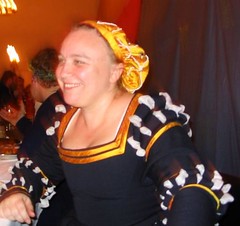
So, I have been fixing some of the problems with the black and gold Cranach frock that I made last year. Here's a slightly blurry photo of me wearing said frock (that I nicked unashamedly from Miss D, because it's the only photo that I have of this dress. Sorry D)

Now, the bodice is pretty good. I'm really happy with the way it turned out - there are a couple of things that I would do differently, but overall it's turned out well. I'll go into some of the details about how I built it a bit later.

The skirt was a disaster, which is odd, because you'd think it would be the easy part. The problem stemmed from the fact that the dress is made from a really soft wool twill. I has a beautiful hand, and a lovely drape, but realistically speaking, was too soft and drapey for a renaissance frock. So over the past couple of weeks I took the skirt off and re-jigged the whole thing. Firstly, I lined the skirt with a ramie-cotton blend fabric, which has enough stiffness to add some body to the soft wool. It's essentially bag lined - the inner and outer layers of the skirt are sewed together at the waist, right sides together, and then flipped inside out. This also meant that I had a nice clean edge to attach to the bodice. Around the hem I have sewn a deep band of......ahem, stiffening fabric.....(I'mnotgoingtotellanyonethatit'stullebecausethen they'llknow) which has the two-fold benefit of kicking the hem out, and helping the pleats form the deep conical shapes that you tend to see in the Saxon gowns in Cranach's paintings. If I were to try a more period approch, I would lean towards canvas, or a woven horsehair braid, although it's possible that I wouldn't need a layer of stiffening, as the quality of the fabric used is likely to be quite different. As all fabric in our time period (600-1600AD) was hand woven - and this is one of those times when the word "always" can be used with impunity - the weave was tighter, and the fabric likely to have quite a different drape. One of these days I'll pull out some of the documentation I've got floating around that talks about the making of fabric, so that I can back up what I'm saying here, but that's a project for later.

Once the fabric was lined, I could re-attach it to the bodice. I used some thick, felty wool to pad out the pleats in the back, but I left this out (this time) in the front, because I didn't want too much bulk over my tummy. Now all that's left is to hem it, and sew on some guarding to match that on the bodice. That ought to be fun - there's over 10 linear metres in that hem, that's a lot of handsewing.......Sigh! I will post some photos once I have figured out why the flash on my camera isn't working.

More frocky goodness

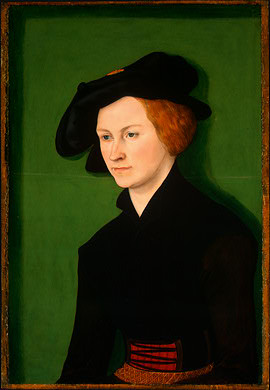
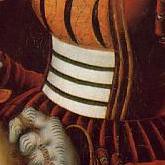
Further to the post before Luke Skywalker (yes, it was terrible) I was talking about the picture of the chicky with the red insert in the front of her frock. Well, here she is!

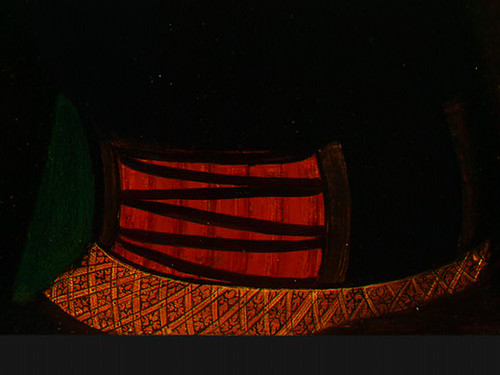
And here is a close-up of her tummy

It's an interesting view - and you can see how it could be interpreted as an under-bodice stiffened with boning or reeds. I am loath to use the word corset here. When I think corset I think of it as being a much more rigid undergarment, used to shape the body, rather than moulding itself to the body's natural shape, and just smoothing everthing out a bit.

A few thoughts on Saxon gown construction

When the beading on the BFoI (see previous post) is all finished, I will need to do the scary part, and start making the frock.....

So, some ideas on the actual construction. The question of the method for making one of these frocks seems to have been more hotly debated than the chicken or the egg. I have seen a number of these frocks which don't match some of the key features in the paintings, which has allowed me to see (without having to make a whole bunch of expensive mistakes myself) what they have been doing wrong.

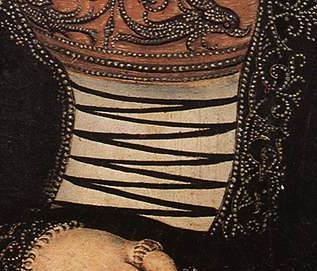
Regardless of what method of construction you want to use, one thing is always apparent in the paintings. The stomacher/placket/white bit under the lacing in the front, is always (look at this rash use of the word always) flat and smooth.

See:

This is one of the things that leads me to belive that this frock was NOT an open fronted dress that was worn over the top of a chemise. Part of my evidence for this comes from looking at this style of dress made by other costumers - often no boning or other stiffening has been used, and this panel has been open to the underwear layer. The effect of this, when the wearer sits or bends, is that the lacing all migrates to the point of least resistance, leaving it sort of bunched up. Also, on an unwise wearer, it can make ones stomach look like a trussed ham. Ew!
So, this could be a boned panel, which is a separate piece to the brustfleck (breastband) or the whole front could be one piece (there is some evidence that this could be the case - in at least one of the 472,863 versions of the suicide of Lucrecia - I'll have to come back and fix that spelling later - the whole front of her dress is folded down to bear her chest, and appears to be all one piece.)
I also have somewhere (and when I find it I will upload it) a picture that shows a woman in an open fronted gown in a similar style, that shows this open section as red. You can also see lines of what could be boning or cording. It's plausable that this is a corded or reed boned corset/underbodice that can be seen through the lacing on the front of the gown.